
In the vast expanse of the Pacific Ocean, two islands emerged from volcanic fury 80 million years ago to become one of Earth’s most extraordinary natural laboratories. New Zealand: Earth’s Mythical Islands unveils the remarkable story of how isolation forged a land so unique that it defies conventional understanding of evolution and ecology. This captivating documentary series reveals how geographic separation created not just a country, but an entire world where ancient forests harbor living dinosaurs, flightless birds rule mountain peaks, and ecosystems operate by rules found nowhere else on our planet. Through breathtaking cinematography and groundbreaking scientific insights, we witness how life doesn’t just survive in isolation—it transforms into something entirely unprecedented.
What Makes New Zealand’s Isolation So Extraordinary?
The tale of New Zealand: Earth’s mythical islands begins with a geological catastrophe that became evolution’s greatest gift. When the supercontinent Gondwana fractured, New Zealand drifted into the Pacific as one of the most isolated landmasses on Earth. This 1,500-kilometer separation from Australia created what scientists call the “New Zealand experiment”—a natural laboratory where evolution could rewrite its own rules.
Without native land mammals except for two bat species, ecological niches typically filled by large predators and herbivores remained vacant for millions of years. This absence allowed birds to diversify in ways impossible anywhere else on Earth. The documentary captures how this mammalian void enabled the evolution of giants: the moa, standing three meters tall, and the Haast’s eagle with its three-meter wingspan—the largest eagle ever to soar through any sky.
The isolation fostered what biologists term “ecological release,” where species expand into roles they could never occupy in more competitive environments. Tree weta, cricket-like insects, evolved to fill the ecological niche of mice. Without mammalian competition, they grew to extraordinary sizes, some weighing more than sparrows. The documentary reveals how these “land lobsters” became New Zealand’s unlikely ecological architects, dispersing seeds and maintaining forest health through their nocturnal wanderings.
How Ancient Forests Harbor Living Dinosaurs
Deep within New Zealand’s mythical islands lies Pureora Forest, where 200-million-year-old ecosystems continue their ancient dance. The documentary ventures into these primordial woods, where kauri trees—giants among giants—have witnessed the rise and fall of entire geological epochs. Some individual trees have lived for over 2,000 years, their massive trunks containing libraries of climate data stretching back millennia.
Beneath these forest cathedrals, the tuatara emerges as New Zealand’s most extraordinary survivor. This living fossil represents the sole survivor of an entire order of reptiles that walked alongside dinosaurs. The documentary reveals how tuataras possess unique physiological adaptations that border on the supernatural: a third eye sensitive to ultraviolet light, the ability to slow their metabolism to near-death levels during cold periods, and teeth fused directly to their jawbones—a feature found in no other living reptile.
The ancient forests showcase evolution’s most creative solutions to isolation. Native frogs lack tadpole stages, developing directly from eggs into miniature adults. This adaptation eliminated their dependence on water bodies that might freeze during New Zealand’s harsh winters. Meanwhile, the documentary captures how native plants developed extraordinary defenses against browsing that never came—thorns pointing inward rather than outward, a botanical paradox that makes sense only in New Zealand’s mammal-free evolutionary context.
Why Flightless Birds Conquered Mountains and Forests
The absence of ground predators allowed New Zealand: Earth’s mythical islands to become a paradise for flightless birds, and the documentary showcases this avian revolution in stunning detail. The takahē, once thought extinct, represents perhaps evolution’s boldest experiment in New Zealand. These massive, flightless rails developed powerful legs and oversized hearts to survive in harsh alpine environments where flying birds would struggle.
Kiwi birds embody New Zealand’s evolutionary paradoxes. The documentary reveals how these nocturnal wanderers evolved mammal-like traits: hair-like feathers for insulation, nostrils at the tips of their beaks for ground-foraging, and the largest eggs relative to body size of any bird. A kiwi chick emerges fully feathered and capable of independent survival—more like a mammal than a typical bird.
The weka, another flightless rail, developed intelligence and adaptability that rivals that of primates. The documentary captures these clever birds using tools, solving complex problems, and even learning to open car doors and unzip backpacks. Their fearlessness and curiosity reflect millions of years of evolution without significant predators, creating personalities more reminiscent of mammals than birds.
Perhaps most remarkably, the documentary showcases how the extinct moa ecosystem functioned. These flightless giants, some weighing over 200 kilograms, shaped entire forests through their browsing patterns. Their disappearance following human arrival triggered ecological cascades that continue reverberating through New Zealand’s ecosystems today, demonstrating how keystone species influence environments for millennia after their extinction.
The Marine Wilderness: Where Ocean Giants Gather
The waters surrounding New Zealand’s mythical islands transform into one of Earth’s most spectacular marine theaters, as captured in breathtaking underwater sequences. The documentary reveals how New Zealand’s position at the convergence of warm subtropical and cold subantarctic currents creates a marine biodiversity hotspot rivaling any tropical reef.
Fiordland’s underwater landscapes showcase evolution’s artistic mastery. Here, massive southern beech forests plunge directly into marine fjords, creating unique ecosystems where freshwater tannins stain the surface layers dark brown. This natural sunscreen allows deep-sea species like black coral forests and glass sponge gardens to thrive in shallow waters, creating underwater cathedrals found nowhere else on Earth.
The documentary captures sperm whale encounters off Kaikoura, where continental shelves drop precipitously into oceanic depths. These deep canyons funnel nutrient-rich waters upward, creating feeding grounds that support not just sperm whales, but dusky dolphins performing aerial ballets and New Zealand fur seals whose populations have recovered spectacularly from near-extinction.
Royal albatross colonies on the Otago Peninsula demonstrate how New Zealand’s isolation benefits marine species. The documentary showcases these magnificent seabirds, with wingspans exceeding three meters, as they master the art of dynamic soaring across Southern Ocean swells. Their breeding colonies represent evolutionary investments in longevity and intelligence—royal albatross can live over 50 years, forming lifelong pair bonds and teaching complex foraging strategies to their single chick each breeding season.
How Extreme Isolation Shapes Unique Ecosystems
New Zealand: Earth’s mythical islands reveals how geographic isolation creates ecological phenomena impossible in connected landscapes. The documentary explores how New Zealand’s ecosystems developed without the “ecological rules” that govern continental environments, resulting in forests where the understory consists of tree ferns reaching 15 meters in height and vines that strangle their host trees from the outside rather than climbing them.
The absence of large herbivores allowed New Zealand plants to evolve extraordinary longevity. Rimu trees can live over 1,000 years, while kauri giants persist for millennia. This longevity created forests with temporal depths unknown elsewhere—individual trees that germinated when Polynesian explorers first glimpsed these islands still dominate canopies today.
Sub-alpine environments showcase perhaps the most dramatic examples of evolutionary creativity. The documentary captures how cushion plants, normally small ground-huggers, evolved into massive dome-shaped formations spanning several meters. These “vegetable sheep” represent 500-year-old organisms that create their own microclimates, harboring entire ecosystems within their dense, protective structures.
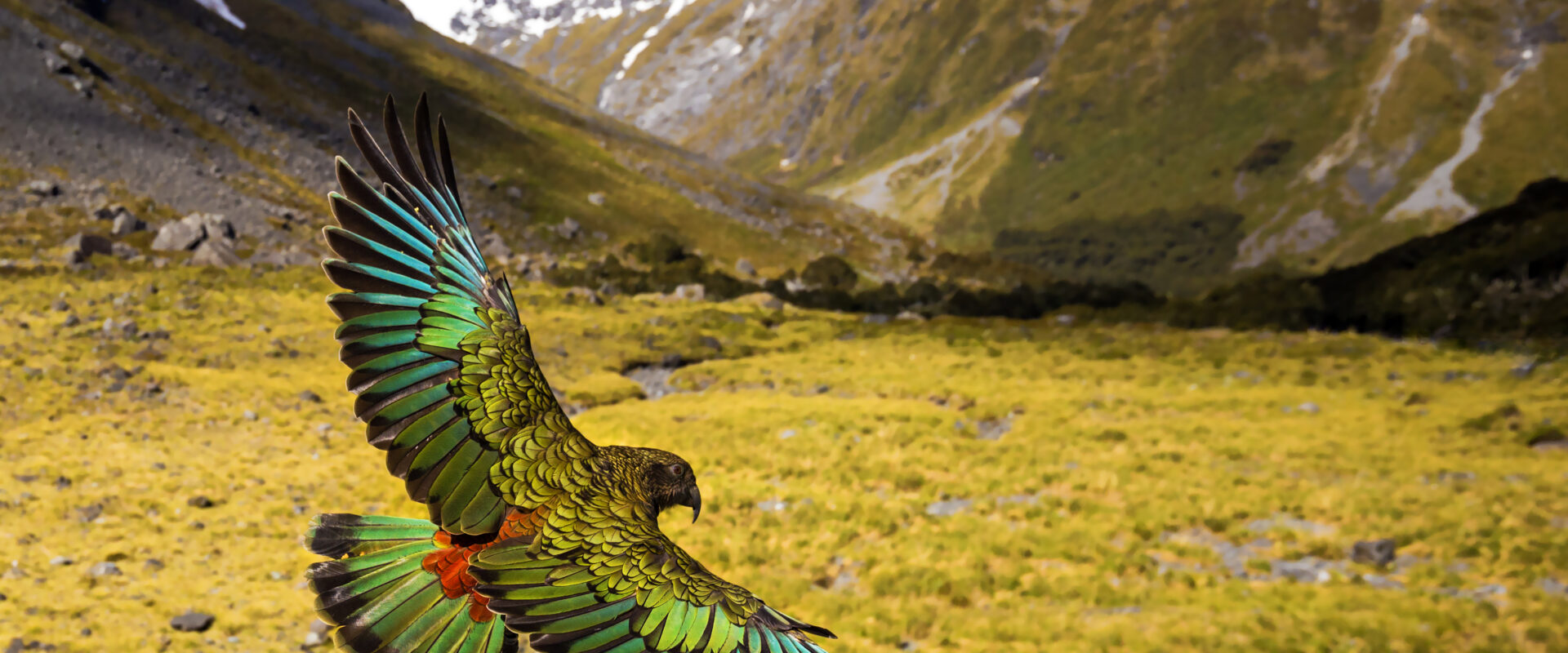
Alpine parrots like the kea evolved intelligence levels typically associated with tropical species, despite living in harsh mountain environments. The documentary reveals how these remarkable birds learned to use tools, solve multi-step problems, and even play elaborate games with inanimate objects. Their curiosity and problem-solving abilities likely evolved to exploit the sparse, seasonal resources of alpine environments where mental flexibility meant survival.
The Human Chapter: Polynesian Pioneers and Ecological Revolution
The arrival of Polynesian explorers around 1280 CE marked the end of New Zealand’s mythical islands as purely natural laboratories. The documentary sensitively explores how these master navigators, following seabirds and ocean swells across thousands of kilometers of open Pacific, brought the first mammals—dogs, rats, and eventually pigs—to New Zealand’s shores.
The ecological impact was swift and dramatic. Moa populations, having evolved without mammalian predators, had no defensive behaviors against human hunting. The documentary reveals how archaeological evidence suggests these giant birds disappeared within 200 years of human arrival, representing one of the fastest megafauna extinctions in Earth’s history. Their disappearance triggered cascading effects throughout forest ecosystems, as seed dispersal networks that had functioned for millions of years suddenly collapsed.
Māori culture developed intimate relationships with New Zealand’s unique ecosystems, creating management systems that recognized the interconnectedness of all life. The documentary showcases how traditional Māori concepts like mauri (life force) and kaitiakitanga (guardianship) developed specifically to manage resources in ecosystems unlike anywhere else their Polynesian ancestors had encountered.
European colonization beginning in the 1800s accelerated ecological transformation. The documentary reveals how deliberate introductions of European species—from deer and possums to songbirds and trout—were motivated by homesickness rather than ecological necessity. These introductions created novel ecosystems where native and non-native species continue negotiating new relationships, some successful, others catastrophic for native biodiversity.
Conservation Success Stories: Bringing Species Back from Extinction
Modern New Zealand: Earth’s mythical islands showcases humanity’s growing understanding of how to restore what isolation created and introduction disrupted. The documentary captures extraordinary conservation successes that offer hope for global biodiversity protection. Offshore islands, cleared of introduced mammals, have become arks where native species can recover their ecological roles.
Tiritiri Matangi Island represents conservation science at its finest. The documentary shows how this 220-hectare island, completely replanted with native vegetation and cleared of introduced mammals, now supports thriving populations of species once teetering on extinction’s edge. Takahē, saddleback, and North Island robin populations have not just survived but flourished, demonstrating how quickly ecosystems can recover when given appropriate protection.
The black robin’s resurrection from just five individuals to over 250 birds illustrates conservation biology’s potential. The documentary reveals how innovative techniques like cross-fostering, where tom tit foster parents raised black robin chicks, enabled genetic bottlenecks to expand into viable populations. This success story pioneered conservation techniques now applied to endangered species worldwide.
Zealandia, a 225-hectare mainland sanctuary surrounded by predator-proof fencing, brings the offshore island conservation model to urban Wellington. The documentary showcases how this “mainland island” allows city dwellers to experience the dawn chorus that greeted Māori ancestors—sounds that had been silent in mainland forests for over a century.
Where to Watch
English:
– New Zealand: Earth’s Mythical Islands – Wednesday, April 1 at 18:05 CET
– New Zealand: Earth’s Mythical Islands – Thursday, April 2 at 12:40 CET
– New Zealand: Earth’s Mythical Islands – Thursday, April 2 at 18:05 CET
FAQ: New Zealand’s Mythical Islands
Q: Why is New Zealand considered so unique evolutionarily? A: New Zealand’s 80-million-year isolation from other landmasses created a natural laboratory where evolution proceeded without large mammals, allowing birds to fill ecological niches typically occupied by mammals and creating ecosystems found nowhere else on Earth.
Q: What happened to New Zealand’s giant birds like the moa? A: The moa and other megafauna went extinct within 200 years of human arrival around 1280 CE. Having evolved without mammalian predators, they lacked defensive behaviors against human hunting and introduced species, leading to rapid population collapse.
Q: How do introduced species affect New Zealand’s native ecosystems? A: Introduced mammals like possums, stoats, and rats prey on native birds and compete for resources. Many introduced species become invasive because New Zealand’s native species evolved without defenses against mammalian predators and competitors.
Q: What makes New Zealand’s marine environment special? A: The convergence of warm and cold ocean currents creates exceptional marine diversity. Deep fjords allow deep-sea species to thrive in shallow waters, while continental shelf drop-offs provide feeding grounds for whales, dolphins, and seabirds.
Q: How successful are New Zealand’s conservation efforts? A: Very successful in controlled environments. Offshore islands cleared of introduced mammals have enabled remarkable recoveries of species like takahē and black robins. Mainland sanctuaries like Zealandia are extending these successes to urban areas.
Q: Can tourists experience New Zealand’s unique wildlife today? A: Yes, but many native species are best observed in protected sanctuaries or offshore islands. Places like Tiritiri Matangi Island, Zealandia, and Stewart Island offer opportunities to see species like kiwi, takahē, and tuatara in their natural habitats.